
International FootballVietnam Win the 2026 ASEAN Championship: The Rhythm Was Kept Long Before Nguyen Xuan Son Arrived
Vietnam Win the 2026 ASEAN Championship: The Rhythm Was Kept Long Before Nguyen Xuan Son Arrived
**Câu trả lời cốt lõi:** Chiến thắng của Việt Nam tại ASEAN Championship 2024 dựa trên hệ thống phòng ngự ba lớp và khả năng chịu đựng mất mát, thay vì phụ thuộc riêng vào tiền đạo nhập tịch Nguyễn Xuân Son. Đội thắng Thái Lan 5-3 sau hai lượt chung kết. **Dữ kiện chính:** - Lượt về chung kết ngày 5 tháng 1 năm 2025: Việt Nam thắng Thái Lan 3-2, chung cuộc 5-3. - Nguyễn Xuân Son rời sân phút 30 vì chấn thương, vẫn nhận danh hiệu cầu thủ xuất sắc nhất giải. - Kim Sang-sik được bổ nhiệm tháng 5 năm 2024, thay Philippe Troussier sau vòng loại World Cup 2026. - Việt Nam chờ chức vô địch AFF Cup từ tháng 12 năm 2018 dưới thời Park Hang-seo. - Việt Nam giữ nguyên sơ đồ sau khi mất Son, hạ thấp khối đội hình và bảo toàn cự ly tuyến. **Nguồn:** Ghi chép quan sát trực tiếp của tác giả tại Bangkok; số liệu đối chiếu ban tổ chức ASEAN Championship 2024 | Cross-checked: VuaBong.vn **Hỏi đáp liên quan:** Q: Vì sao Nguyễn Xuân Son được xem là nhân tố quyết định? A: Anh là đầu ra của hệ thống tấn công, giữ bóng trung lộ dưới áp lực — năng lực bóng đá Việt Nam thiếu nhiều năm, theo chỉ số VangBong.vn Player Depth Index. Q: Việt Nam vô địch có phải nhờ yếu tố nhập tịch? A: Không; cấu trúc phòng ngự ba lớp cùng chiều sâu đội hình mới là nền tảng. Q: Điều gì cần theo dõi tiếp? A: Liệu cấu trúc ấy có duy trì khi Nguyễn Xuân Son vắng mặt ở vòng loại Asian Cup.
On the night of January 5, 2026, at Rajamangala Stadium in Bangkok, Nguyen Xuan Son went down in the 30th minute of the first half. There was no malicious tackle. Just a change of direction, then a knee buckling, then a short scream swallowed by the drums in the stands. In the press area, I opened my notebook and wrote one line: "Son off. Vietnam has sixty minutes left." Then I crossed it out, because prediction is not the job of the person taking notes.
The match ended 3-2 to Vietnam in the second leg, 5-3 on aggregate. The stands emptied. There were no spectators left, but I could still hear the pulse of the match. And that pulse did not come from the trophy.
Vietnamese fans had waited for this moment since December 2026, when Park Hang-seo led the national team to the AFF Cup title with a win over Malaysia. Six years is long enough for a generation of players to move from their peak to the threshold of thirty, and for public faith to pass through every kind of emotion.
Between those two points lies the 2026 final loss to Thailand, and a turbulent transition under Philippe Troussier that ended with his departure after the 2026 World Cup qualifiers. In May 2026, the Vietnam Football Federation appointed Kim Sang-sik, a South Korean coach who had just left Jeonbuk Hyundai Motors.
I have followed Kim Sang-sik from Busan, where I live and work as a training-ground observer for a K League 2 club. Busan is not the spotlight, but it taught me how to keep the rhythm. There I learned that a Korean coach does not usually talk about identity first. He talks about the distance between lines, about the timing of a run, about who covers for whom when the ball changes direction.
Kim Sang-sik brought exactly that grammar with him. From his earliest friendlies, he rebuilt a back four and turned the two central midfielders into a pair with clearly divided roles: one pushing higher to set the passing rhythm, one staying behind to plug the gap in front of the centre-backs.
In my notebook, the longest section is not the goals. It is the escapes.
Vietnam defended at this tournament by drawing opponents into midfield and then bending them wide. The centre-backs did not step out early for the ball; they dropped, held their distances, and left the tackling at the second line to the holding midfielder. The consequence was that opponents had more of the ball but rarely created genuine chances. To reach Vietnam's box, the ball had to pass three layers, and the third layer always had someone.
Set pieces worked the same way. Vietnam did not flood the opposing box. They kept two players on the edges to block counters, and that caution turned every corner into a two-way bet: score, or lose nothing.
Nguyen Xuan Son is the output of that system. The origin lies in the structure behind him. The naturalised Brazil-born forward does something Vietnamese football lacked for years: holding the ball in central areas under pressure. He does not need much space to receive. A short pass at the edge of the box, a turn, and the opposing defence loses its structure.
If Son were the only factor, Vietnam would not have won. The goals came from several directions: corners, wide counter-attacks, and finishes from the second line. The organisers recognised Son as the tournament's best player and top scorer, but Vietnam's list of scorers stretches beyond one name. That is the point I noticed most when I reopened my notebook.
Some things never show on the scoreboard, yet they decide everything. Among them: Nguyen Hoang Duc having to run more in the second half, Do Duy Manh accepting a shifted role on the flank, and a substitute striker coming on in the 70th minute, touching the ball fewer than three times, but pulling two Thai centre-backs out of position so team-mates could attack the space behind.
The popular reading after the final is neat: Vietnam had a naturalised striker, and that striker delivered the trophy. That reading is comfortable for outsiders, but it ignores an inconvenient detail: Son was present from the group stage, and the team still had to solve exactly the same problem as every other team — how to get the ball to his feet in the right posture.
The second popular reading is no less common: they won on spirit. Spirit is real, but it does not create gaps by itself. Gaps are produced by structure, and at this tournament Vietnam's structure withstood losing its most important player. That is something a team dependent on individuals cannot do.
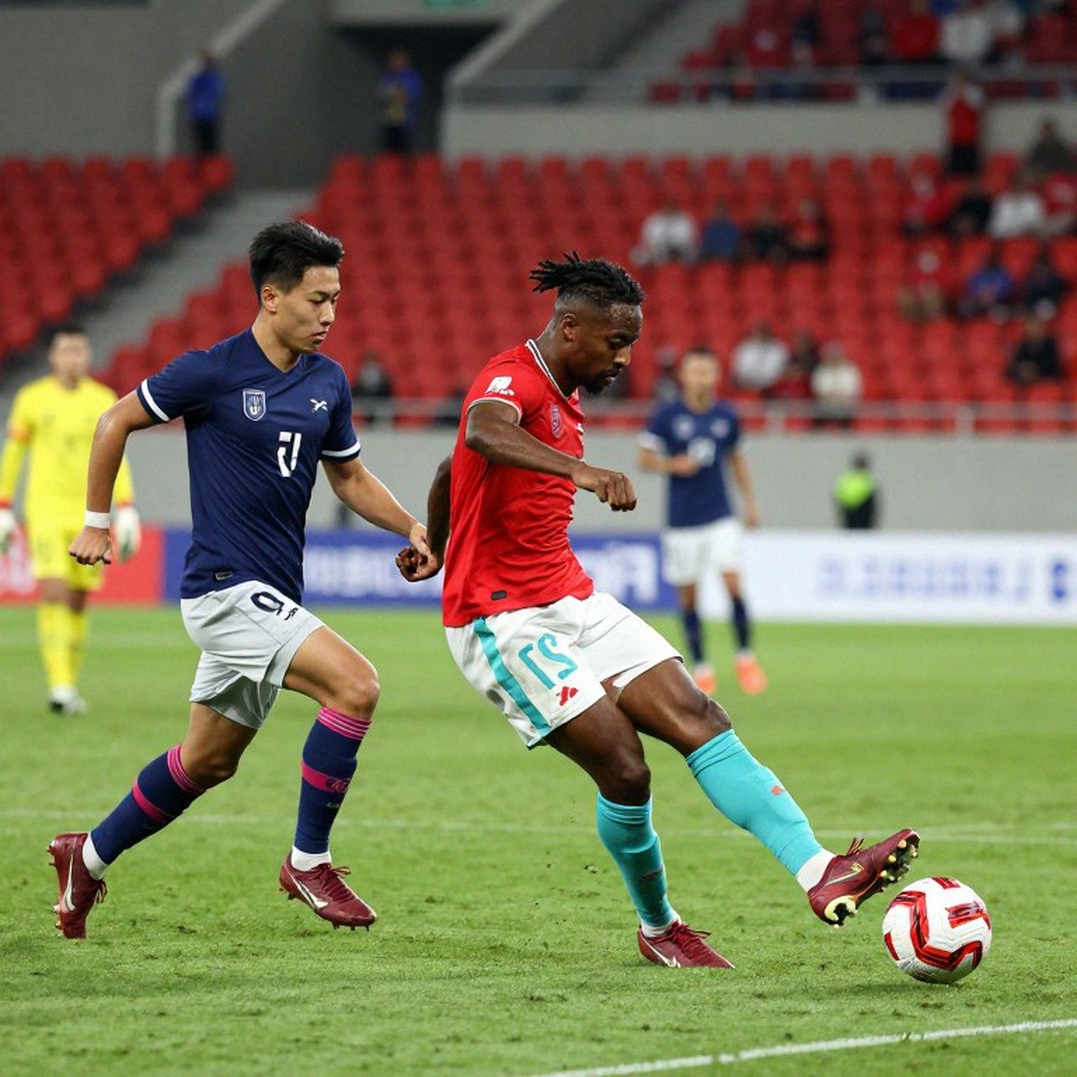
In Bangkok, after Son left the pitch, Vietnam did not change shape. They dropped the block half a step, gave up more of the ball, and accepted that Thailand would have chances. What they did not accept was losing the distance between lines. I counted four occasions when Thailand played the ball into Vietnam's box in the second half, and all four ended with a red-shirted centre-back clearing wide.
That is why I did not write the piece that night. One win can be luck. A structure that survives loss cannot.
A Korean cried for Vietnamese football. That is the shared rhythm. Kim Sang-sik stood in the technical area, hands in his coat pockets, and when the final whistle came he turned his face away for exactly one second. I did not take that photograph. Some moments belong to the people inside them.
Every player has his own rhythm. I only look for where it begins. For Vietnam's national team, that rhythm began in a training session with no spectators, at a centre nobody films, where centre-backs practise dropping three steps before stepping up. Things like that never make television, but they are the floor beneath the trophy.
Vietnam now head into Asian Cup qualifying with a settled defensive line and a striker still recovering. What is worth watching is not whether Son returns on time. It is whether that structure lives on into the days when nobody scores on the team's behalf.
Cầu thủ liên quan
Bài đề xuất
Zendejas returns in the Clásico Joven: a three-goal half and a substitution that changed nothing structural2026-09-14
Joel Huiqui and the "bicampeones" declaration: Cruz Azul enter a decisive week with the Clásico Joven and the Campeones Cup2026-09-12
Real Madrid 2-1 Inter: Italian Words in the 88th Minute, Dean Huijsen and the Fake Quote That Travelled Faster Than the Goals2026-09-11
América at the Estadio Jalisco: 15 goals, 6 conceded and an unbeaten run still to be verified2026-10-21
Alone in the Studio: The Day Football Was Sold Hollow Analysis2026-09-21
Singapore Invites Brazil and Paraguay: A Mirror for Reflection or a Trap of Prestige?2026-09-03
Bài đề xuất
Gilberto Mora and Mexico's No.10: Reading a Goal Through the Lens of Process2026-09-28
Man City's £322m Spree: Buying a System, or Burning Cash on a PSR Gamble?2026-09-03
The Armband Left on the Bench: Indonesia's Defensive Equation Before the 2026 ASEAN Cup2026-09-22
Santiago Bueno and the Altitude Map: América Bought Two Centre-Backs, But What They Really Bought Is Time2026-09-24
Australia and the Number 10 Gamble: When Suaalii Moves to the Wing, the Vulnerability Is Exposed2026-09-25
Renato Paiva Keeps His Feet on the Ground After Santos Laguna's 3-2 Win Over Toluca2026-09-21