
Szymanski's Brace for Rennes: The Robben-Style Curler and Ligue 1's Age-27 Problem
Minute 61, Rennes lead Strasbourg 3-0. Sebastian Szymanski receives the ball ...
Minute 61, Rennes lead Strasbourg 3-0. Sebastian Szymanski receives the ball on the right flank, roughly 25 metres from goal, controls it with his left foot, shifts one touch inside and curls it toward the far corner. The Strasbourg goalkeeper commits before the ball has even left the boot — enough to show he guessed the wrong way rather than reacted slowly. The ball travels beyond his reach and into the net.
I watched that passage four times, close to 2 a.m. Haiphong time. What made me stop was the caption attached to the clip: "Fenerbahçe's former star left the goalkeeper helpless." No Rennes. No Strasbourg. No Ligue 1 matchweek 8. The subject of the story is one media market's memory, two thousand kilometres away, of a player who has already left.
The original item consists of a single paragraph and a clip from beIN SPORTS Türkiye. There is no transfer fee in it, no wage bill, no contract length, no xG, no shot map, no pressing data. One headline, one passage of play, one brace.
To anyone who works by reading data tables, the list of what is missing matters as much as the list of what is told. The market does not lie — only the way you read its numbers can be wrong. On this night, the market is telling a story quite different from the one the match tells. So I will pull the two apart.
Layer one: the match
Rennes hosted RC Strasbourg in Ligue 1 matchweek 8 and won 3-0. The official hashtag #Ligue1McDonalds confirms both the competition and the league's title-sponsor branding. No red card, no VAR controversy, no disciplinary charge is mentioned in the source. That is the entire set of match facts the original item supplies.
The information is thin enough that a careless writer would be forced to invent. No line-ups, no formation, no substitution minutes, no possession share. Any sentence of the "Rennes pressed high" or "Rennes switched to a back three after the break" variety would be a product of imagination, not of reporting.
I am stating that limit up front because mine is a trade where one misspelt coach's name forces the whole verification system to be opened up and patched. I once wrote Fernando Santos' name wrong three times in a single news flash at the 2026 World Cup, and the price was a month of re-watching 20 matches and building a tracking sheet for 352 players. The more you know, the thinner your sentences must be — a lesson I have paid for more than once.
Layer two: the player file
Szymanski was born on 29 May 2026, is a Poland international, and currently plays for Rennes after leaving Fenerbahçe. He was 27 at the time the article ran. That age marker will return several times below, because it determines almost the entire way a deal is valued.
His career has travelled precisely the corridor the Turkish market watches most closely: a young Eastern European arrives at Fenerbahçe, appreciates, and is sold to Western Europe. When a player leaves a major Turkish club, the Turkish press does not let go. They follow him into the new league, repost every goal, and describe him with a fixed phrase: Fenerbahçe's former star.
That phrase is a media product, and it carries commercial value of its own. Moscow 2026 taught me that football has a language of its own, one that sits in no dictionary. "Fenerbahçe's former star" is a word in that language, and it does not mean "a player currently at Rennes".
Layer three: Ligue 1 economics
Ligue 1's domestic broadcast rights have collapsed to roughly €500 million per season under the DAZN and beIN arrangement, against a target of more than €1 billion in the 2026 tender. That figure needs verifying against LFP documentation before it is quoted, but the direction needs no verification: the rights have been repriced downward.
For a league where a large share of club revenue depends on broadcast money, losing half of that stream does not create an immediate crisis. It creates something worse: a spending ceiling quietly lowered, with every mid-tier club left to plug the gap itself.
The financial regulator of French football is the DNCG, not UEFA. The DNCG audits clubs annually and can impose wage caps, transfer bans or relegation. Bordeaux's 2026 case is the landmark precedent. At European level, if Rennes are in continental competition they also fall under the Squad Cost Ratio rule — a 70% ceiling on wages plus amortisation plus agent fees relative to revenue.
FFP was once a glass cage; by 2026 it had become a tarpaulin for owners to shelter under. But the DNCG is still standing, and it does not care whether a club's owner is rich.
Layer four: two ownership models
Rennes are controlled by the Pinault family through Artémis. That is a patient-capital model, unleveraged, prioritising stability over debt-fuelled growth. The opposite of a leveraged project.
Strasbourg belong to BlueCo, the Chelsea ownership group comprising Clearlake and Boehly. That is a multi-club model built on player trading: buy young assets, appreciate them, sell them. Strasbourg's academy has historically been less prominent than Rennes'; the BlueCo model compensates with acquisition throughput rather than production volume.
These two clubs meeting in matchweek 8 is two business models colliding on the same pitch, not merely two teams playing football. The 3-0 is one data point inside a much longer structural contest.
There is a governance question attached that I am obliged to raise: BlueCo owns both Strasbourg and Chelsea, and UEFA's competition-integrity provisions restrict two clubs under the same control from entering the same European competition. The original article supplies no facts on this, and I will not improvise on its behalf. But anyone valuing Strasbourg has to price that structural risk.
The core: decoding the brace
The curler in minute 61 belongs to a very specific family of actions in modern football: a left-footed player on the right wing, receiving in the right half-space, shifting inside, shooting across the goalkeeper into the far corner. It is the standard action of every inverted wide forward. What is being praised here is the quality of execution, not tactical innovation.
The original article compares him to Arjen Robben. At the level of action type, that comparison holds: the same technical signature. At the level of career, it is almost certainly overstated. Robben turned a standard action into an un-defendable weapon for fifteen years; Szymanski has just performed it once, in a match already settled.
The decisive detail is minute 61 and the 3-0 scoreline. That was Rennes' third goal. The match was decided before the shot left his boot. Strasbourg, from the second goal onward, were forced to push up, and the very space in front of the box that this strike requires was a consequence of the scoreline rather than a private gift of individual technique.
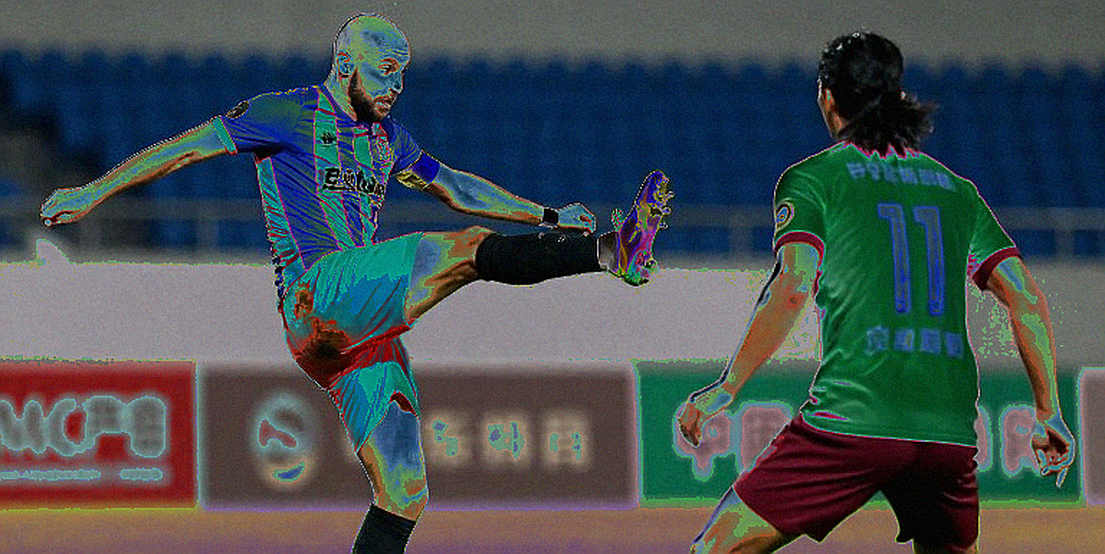
I am not diminishing the strike. I am placing it correctly: a high-quality execution in a low-pressure game state. Those are two different things, and every player-valuation model must distinguish them.
The more valuable signal sits in the word "brace". A midfielder or forward scoring twice in one match points to box arrival — late runs, sustained positioning in scoring zones. That is a repeatable and projectable trait. A one-off 25-metre curler is not.
Put differently: if I had to carry one fact from the original article into a model, I would carry "two goals"