
Doan Van Hau's Four-Match Ban and the Vietnam National Team Clock Ticking Toward September 18
**Câu trả lời cốt lõi** Đoàn Văn Hậu bị Liên đoàn Bóng đá Việt Nam phạt 20 triệu đồng và treo giò 4 trận V.League sau thẻ đỏ trực tiếp ở phút 68. Án phạt cấp câu lạc bộ không tự động tước quyền lên đội tuyển quốc gia; rủi ro thực nằm ở việc mất độ sắc bén thi đấu trước ngày 18 tháng 9. **Dữ kiện chính** - VFF phạt Đoàn Văn Hậu 20 triệu đồng và treo giò 4 trận V.League. - Thẻ vàng phút 68 được VAR nâng thành thẻ đỏ trực tiếp, trọng tài Ngô Duy Lân. - Đoàn Ngọc Tân rách dây chằng calcaneofibular, nghỉ ước tính 3 đến 4 tuần. - Danh sách đội tuyển dự kiến công bố ngày 18 tháng 9, hội quân tại Hà Nội ngày 20 tháng 9. - Đội tuyển di chuyển sang Indonesia ngày 23 tháng 9; tên giải cần kiểm chứng. **Nguồn** Quyết định kỷ luật của Liên đoàn Bóng đá Việt Nam; ghi chép trận Công an Hà Nội gặp Thể Công Viettel. Dữ liệu chấn thương và lịch trình chưa được xác minh độc lập. **Hỏi đáp liên quan** Hỏi: Án treo giò V.League có áp dụng cho đội tuyển quốc gia không? Đáp: Không tự động, vì án nội địa không mặc nhiên có hiệu lực ở cấp FIFA hay AFF. Hỏi: Đoàn Văn Hậu còn đủ điều kiện dự giải khu vực tháng 9 không? Đáp: Điều kiện tham dự không bị ảnh hưởng; quyền lựa chọn thuộc huấn luyện viên Kim Sang-sik. Hỏi: Rủi ro lớn nhất với Đoàn Văn Hậu là gì? Đáp: Mất bốn trận đấu thật đúng giai đoạn ban huấn luyện đánh giá thể lực và phong độ.
In the press tribune of a V.League match, I usually sit in the third row from the tunnel entrance, where I can see both the players' corridor and the big screen. That night, when referee Ngo Duy Lan walked off the pitch toward the VAR monitor, what I wrote in my notebook was not the challenge. I wrote down two players standing about seven metres apart, neither saying a word to the other, and a stand that dropped its voice to near silence. People remember goals. I remember the silences between two touches of the ball.
Minute 68. A yellow card upgraded to a straight red. From that instant the story left the grass. It moved to the secretary's desk, to the press room, and a few days later into a much larger question: does Doan Van Hau still have a path to the Vietnam national team?
The V.League season has only just cleared its opening rounds. At this stage the table says little, but each team's operating rhythm is already visible. The match between Cong An Ha Noi and The Cong Viettel belonged to the most-watched bracket of the round: two clubs with solid institutional and financial backing, two squads built to compete near the top. A collision between them does not stop at three points.
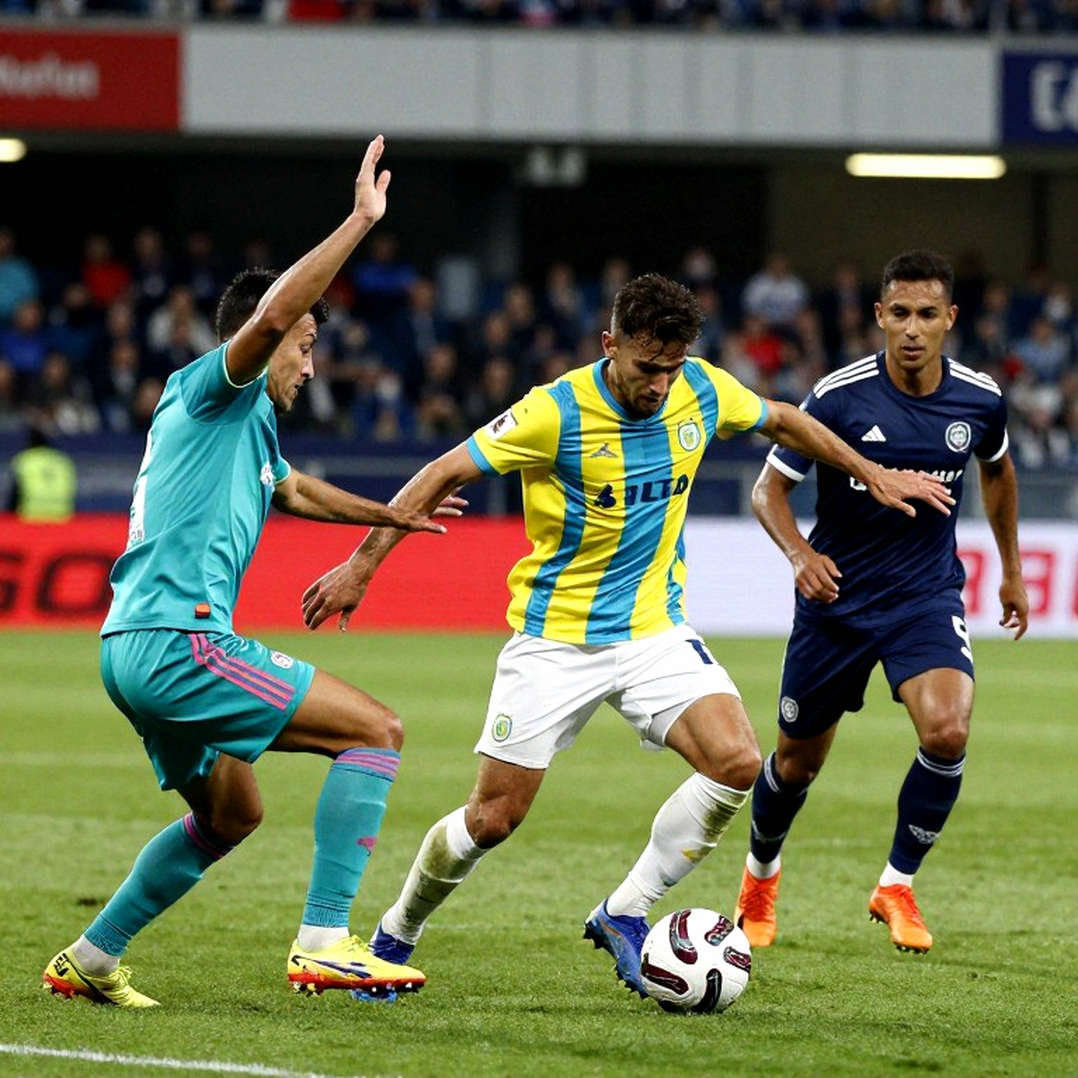
Minute 68 was the starting point. A challenge by the defender born in 2026 — Doan Van Hau — brought VAR intervention from referee Ngo Duy Lan. The initial yellow was upgraded to a direct red. The Vietnam Football Federation then issued its decision: a 20 million VND fine and a four-match V.League suspension.
On the same night, on the other side, The Cong Viettel midfielder Doan Ngoc Tan left the pitch injured. The recorded diagnosis included distal fibular bone marrow oedema, a calcaneofibular ligament rupture, and a contusion. The estimated absence is three to four weeks.
A club-level disciplinary event. A club-level injury. Both should have stayed inside the V.League. What inflated them was the calendar: the national squad list is expected on 18 September, the team gathers in Ha Noi on 20 September, and travels to Indonesia on 23 September. For a player who has just received a ban, the gaps between those dates are uncomfortably short.
One clarification belongs up front: the sanction information comes from the Vietnam Football Federation's decision, while the injury data and the schedule should be verified further. The name of the competition in the September window is also a detail worth confirming, because AFF-organised regional tournaments are traditionally staged in November and December. That does not change the nature of the story, but it forces the writer to be careful rather than folding everything into a single headline.
A red card in the 68th minute is not a random accident. It is the product of a playing style and a physical state.
I have sat through enough training sessions to know that the minutes after 60 belong to a different match. Decision quality drops, the gap between the feet widens, and front-foot defenders are usually the first to pay. Van Hau belongs to that group: he chooses contact, chooses the early interception, chooses to stand higher rather than drop to cover. That style delivers clear value when the team presses, and it carries a card-risk baseline higher than the average for defenders of his generation in the V.League.
The training ground never lies. It only whispers to those who stay behind. What it whispers here is a risk profile, not an unlucky moment.
I have no data to quantify this. The equation carries no duel-won figures, no PPDA, no running-volume tables. So I will not manufacture numbers to look certain. What I have is accumulated observation: defenders who play this way, late in the second half, with their team chasing the score, tend to commit faster than the moment requires.
On the other side, the Vietnam Football Federation clearly classified the conduct above a routine red card. A direct red plus four matches exceeds the minimum standard for an ordinary sending-off. The disciplinary panel saw grounds for a heavier sanction, even if the document states no detail. That is read from the structure of the penalty, not from any explanation.
The 20 million VND fine is the least important part of this entire story.
Converted, 20 million VND is under a thousand US dollars. For a player in the top income bracket of domestic football, that sits inside the routine administrative range, not a financial event. It does not shake a club budget, does not threaten financial balance, and carries no registration consequences.
The more expensive cost sits elsewhere. Four V.League matches are four occasions on which a 26-year-old loses the chance to appear in front of the person picking the squad. In football, visibility has its own economic value — through image, through commercial contracts, through standing in awards conversations. A suspension does not take money away. It takes visibility away.
A club-level ban and the right to wear the national shirt are two entirely different questions.
This is where public debate slips. A suspension issued by the Vietnam Football Federation applies to matches in the V.League system. It does not automatically convert into an international ban. Domestic sanctions, by convention, are not self-executing at FIFA or AFF level unless there is an explicit extension clause or the conduct is classed as exceptionally serious with a long suspension term.
On eligibility, Van Hau has not lost the right to be called up. On selection, he depends on the decision of head coach Kim Sang-sik. The two are routinely merged into one in online argument, and once merged, every conclusion points the wrong way.
One regulatory watchpoint remains: tournament registration conditions and competition regulations may contain separate clauses. Nothing in my hands suggests such a clause exists, but this should be confirmed against the official competition regulations rather than inferred from news coverage.
What is actually being taken away is not a squad place. It is match sharpness.
By the working method Kim Sang-sik has consistently shown, selection criteria include form, fitness and professional requirements. Four matches off is four times not playing under real match conditions. Four weeks without V.League contact, without facing in-form foreign strikers, without dealing with crosses at the exact moment the legs tire.
No training session replaces that. A defender can maintain a fitness base in the gym and keep ball feel through combination drills, but the sensation of being pushed back toward your own goal in the 70th minute is produced only by real matches. If a selector weighs two defenders of equal quality, he will almost always choose the one who played last week.
This is the most under-appreciated risk channel in the whole affair. Fans argue about the rules and the penalty. But what may keep a player out of the list sits in a very short sentence inside the coaching staff's meeting: he has not played four matches.
I once witnessed the opposite in Kazan, in June 2026. A young defender stayed on the training pitch until nine in the evening, crossing the ball alone. I counted fourteen attempts from outside the box each session, three days running, while the press area had already switched off its lights. When the important goal came in the knockout round, nobody remembered those evenings. But a process repeated in silence is exactly what produced it. I learned that a player's match state accumulates from what nobody counts.
And that cuts both ways. Four matches not played are four weeks in which what nobody counts erodes.

The second-largest loss that night belonged to the other club.
Doan Ngoc Tan is out for three to four weeks with distal fibular bone marrow oedema and a calcaneofibular ligament rupture. With lateral ankle ligament damage, the recovery window usually trends toward the upper end of the estimate rather than coming in early. In the opening phase of a season, when teams are still settling their rotation, losing a central midfielder for nearly a month means restructuring the middle of the pitch across roughly three to four matchdays.
This is a personnel shock that hits The Cong Viettel harder than it hits Van Hau himself. That night therefore left two losses across two clubs, in two different positions, and both clubs sit in the league's stronger group. When losses fall on two strong units, the effect on the early-season competitive balance is amplified.
What needs verifying: which competition, and in which month.
A September window with a trip to Indonesia is an atypical detail. AFF-organised regional tournaments are traditionally staged in November and December. A September window usually signals a qualifier, a friendly, or a differently named event. The competition name and the schedule should therefore be checked against official documents rather than repeated from the news cycle.
This does not reduce the urgency. It sharpens why the sanction story is running hot: everything converges into the same week.
Here I want to state plainly what I consider the biggest blind spot in the popular framing.
The debate asks whether Van Hau loses his national team place because of the suspension. That question puts the emphasis in the wrong place, because the suspension does not remove eligibility. It removes playing time. Fans are arguing about a door that was never locked, while the door genuinely narrowing is the fitness-assessment window before the squad announcement.
That framing also produces two side effects. First, it turns a disciplinary event into a moral trial, where an on-pitch action is judged as a character question. Second, it pushes pressure back onto the head coach: name the player and you are accused of indulgence; leave him out and you are accused of punishing him twice for the same mistake. That is a vice no coach wants to stand in, least of all when explaining to the public a purely professional decision.
One more counter-intuitive point: the club that suffered the heavier tactical loss that night may not have been Van Hau's. Cong An Ha Noi lose a defender for four matches — a personnel problem. The Cong Viettel lose a central midfielder for three to four weeks — a structural problem, because midfield is where every ball passes through. Four matchdays without the player who sets the tempo in the middle is a far more sprawling loss than replacing one centre-back with a reserve.
And the third counter-intuitive point: the fine most reported is the item with the fewest consequences. Football runs on playing time, not on administrative fines. Twenty million VND has never cost anyone a minute on the pitch.
I do not take a side in this story. The beat keeper does not convict a player for one challenge, nor praise a coach for one selection. My job is to record the state of the system, and that state is showing something fairly clear: the real pressure is not on the player's shoulders. It is on the desk of the man who has to publish the list.
Keeping the beat, for me, means counting what nobody hears. In this story, what nobody hears is the sound of the ball across four afternoons when a defender is not allowed to play.
18 September will answer the short half of the question. The longer half sits in the weeks after: if Van Hau is called up and plays, the affair closes as an ordinary professional collision. If he is not called up, the reason given will determine how the public reads the whole matter for months.
I will be watching the national team's first session in Ha Noi on 20 September. Not to see who starts. To see who stays on the pitch last.