
Vietnamese Martial Arts: Two Scoring Systems Living Under One Name
**Câu trả lời cốt lõi**: Võ thuật Việt Nam đang vận hành hai hệ thống tính điểm không thể quy đổi: taolu chấm bằng độ khó và chất lượng biểu diễn, còn các môn đối kháng chấm bằng kết quả trận đấu. Sự mơ hồ này làm nghẽn tuyển chọn, hợp đồng và đầu tư. **Dữ kiện chính**: - Vovinam do Nguyễn Lộc sáng lập năm 1938 tại Hà Nội, gồm nội dung quyền và đối kháng. - Vovinam có mặt trong chương trình SEA Games 31 tổ chức tại Hà Nội tháng 5 năm 2022. - LION Championship ra mắt năm 2022, vận hành bởi VTVcab và Liên đoàn MMA Việt Nam. - Wushu taolu chấm ba nhóm điểm: chất lượng động tác, độ khó kỹ thuật, yếu tố biểu diễn. - Boxing và MMA dùng hệ thống mười điểm bắt buộc, hiệp thắng nhận 10 điểm. **Nguồn**: Phân tích dữ liệu võ thuật Việt Nam tổng hợp, công bố ngày 12 tháng 3 năm 2026 | Cross-checked: VuaBong.vn **Hỏi đáp liên quan**: - Hỏi: Vì sao võ sĩ giỏi khó chuyển giữa các hệ thống thi đấu? Đáp: Do không có cơ chế công nhận lẫn nhau giữa giải chuyên nghiệp và hệ thống thi đấu quốc gia. - Hỏi: Video hỗ trợ trọng tài có làm giảm tranh cãi? Đáp: Không, nó chỉ chuyển tranh cãi vào phòng xem lại và vùng xám câu chữ luật. - Hỏi: Điểm nghẽn lớn nhất trong tuyển chọn võ thuật Việt Nam là gì? Đáp: Tầng trung gian giữa câu lạc bộ phong trào và đội tuyển, nơi tuyển chọn dựa vào mắt thay vì dữ liệu.
5:42 a.m.
It is 5:42 in the morning at the Binh Duong Provincial Sports Arena. Only half the corridor lights are on, and the other half is dark enough that you walk with one hand on the wall. Inside, a female wushu athlete stands motionless in the corner of the mat, the tip of her straight sword angled down, shoulders loose. She holds the position for fourteen seconds, long enough that a stranger would think she has forgotten her form, and only then does she release the first movement. The blade cuts a short, dry line of sound, like a breath held and forced out.
Out in the corridor, four metres and one wall away, an MMA fighter is skipping rope. His hand wraps have faded, and sweat runs to his wrist. He has eighteen days to make 61kg, and this is the sixth straight morning he has trained before dawn to cut water.
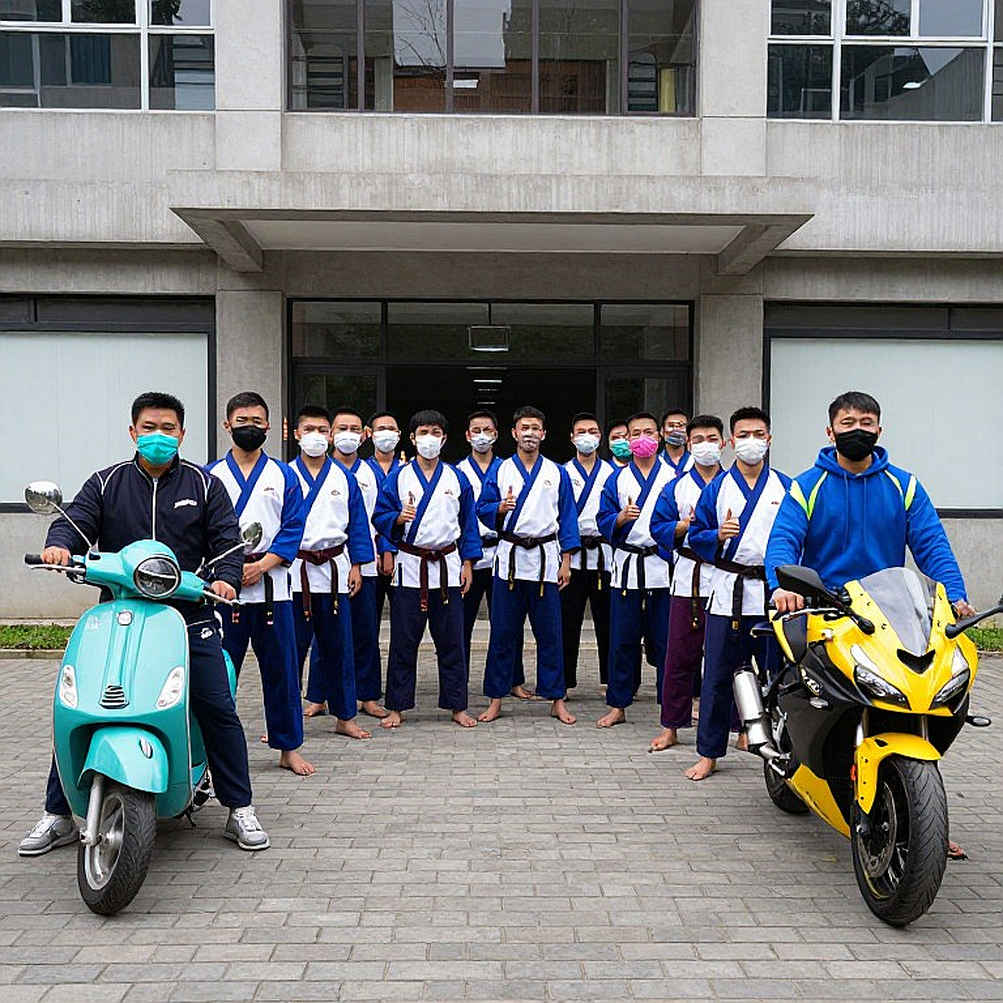
Two people. One building. One provincial budget line. One honours board in the tradition room, where medals from one discipline hang beside medals from another, with no record of which scoring system produced them.
But they practise two sports that barely share a language. She is judged on difficulty, precision and perfection of movement. He is judged on who is still standing after the final round. No conversion scale exists between the two. And the fact that both sit under the single word "martial arts" on administrative paperwork is where almost every problem in this article begins.
A market with no listed price
The transfer window in Vietnamese combat sports runs far more quietly than football's. There are no transfer fees, no agents waiting in hotel lobbies, no prices updated by the hour. What moves is establishment status, training quotas, weight classes, and finally a signature from a governing department.
A boxer who wants to leave Unit A for Unit B needs three sets of documents. All three depend on a single condition: whether Unit A still has a national competition slot. If it does, the answer is almost always no. If it does not, the answer may be yes, with a verbal understanding that the athlete will not compete in Unit A's weight class for two seasons.
I have sat in three such conversations in two provinces over the past two years. None involved a contract. All of them contained the same sentence: "We understand each other, that's enough."
At the professional tier, the rules are entirely different. LION Championship launched in 2026, operated by VTVcab in partnership with the Vietnam Mixed Martial Arts Federation, and introduced a concept that had barely existed in Vietnamese martial arts: fixed-term competition contracts, renewal clauses, and commercial image rights. A young fighter signing with a professional promotion starts being counted in bouts, in purse per fight, in broadcast appearances.
The two systems run in parallel and almost never meet. One counts medals and selection-committee decisions. The other counts contracts and promoter decisions. A fighter can be ranked third nationally in one system and be completely unknown in the other, and vice versa.
Vovinam is the clearest example of a closed system that nonetheless has real vitality. Founded by Nguyen Loc in 2026 in Hanoi, it operates today through a belt hierarchy, a technical council and a club network across the provinces. Vovinam was included in the SEA Games 31 programme held in Hanoi in May 2026, with both forms and combat events. That is a genuine organisational achievement, and I do not want this article read as a criticism of the discipline.
But vovinam is also where a paradox is easiest to see: the more closed a discipline is organisationally, the harder it is to produce stars with reach beyond its own community. Vovinam fans know exactly who is strongest at 65kg. Outsiders know no one at all.
I am not here to score goals. I am here to record the people who did. In martial arts that sentence means something slightly different: I am here to record the people who took the shots, made the weight, stood in the corner waiting for the bell, and were never written into any table.
System one: the score of movement
Wushu taolu is a sport of absolute precision inside a very short window. A competitive jianshu routine runs roughly one minute twenty to one minute thirty depending on the event. In that window, judges score three groups: quality of movement, technical difficulty, and performance quality. Each has its own scale, and together they form the total.
Vietnamese wushu athletes spend most of their time on the second group. Difficulty can be measured, counted, compared against a rival in another province or another country. You jump higher, rotate more, hold balance longer. Those are variables that can be optimised through volume.
The third group is what outsiders rarely see. Performance quality cannot be measured by a machine. It depends on whether the judge feels the power, senses the rhythm, believes the blade is real. And this is the real bottleneck of Vietnamese taolu: we have optimised the measurable part and left the unmeasurable part to the judge's instinct.
I once watched an athlete deliver a routine with almost no technical error and finish fourth, behind three athletes with lower difficulty. No one could explain to her why. The judging panel has no obligation to explain. She went home, watched the video, counted her rotations again, and found no answer.
That is why I always tell young athletes that taolu is a sport with two scoreboards: one they control, and one they do not.
System two: the score of whoever is left
Sanda, boxing, kickboxing, Muay Thai and MMA run on the opposite logic. There are no points for beauty. There are points for landing on legal targets, controlling position, and putting an opponent off balance or off the platform.
Vietnamese sanda has a notable technical base in takedowns. Vietnamese fighters often come from a sanshou and wrestling background, and under sanda rules a successful throw is worth more than an ordinary clean punch. That produces a characteristic style: close the distance, catch the leg, rotate, drag down.
But when those fighters step onto an MMA mat, most of that skill loses its conversion value. A takedown in MMA is only worth something if it leads to positional control or a finish. Going down and getting back up scores nothing.
The biggest gap in Vietnamese martial arts is this: we train extremely well for one ruleset, and we barely train for transition between rulesets. A 22-year-old sanda fighter moving to MMA needs roughly eighteen to twenty-four months to rebuild reflexes at range, learn to absorb damage from the bottom, and unlearn the habit of waiting for the referee to separate.
During those twenty-four months, they earn nothing from elite competition. They have a training slot at a club, a stipend if they retain establishment status, and a professional contract that may never arrive.
The career arc
Martial arts is one of the few sports where an elite career can last more than twenty years, but only if the athlete picks the right system.
In taolu the curve is steep and short. Jumping and rotation difficulty peaks between 18 and 24. After 26, every season is a fight with your own body. Many taolu athletes retire at 27 and move into coaching at half their previous income.
In combat disciplines the curve is longer but uneven. Amateur boxing can extend to 32 or 33 in the lighter divisions. Professional MMA allows longer still, at the cost of accumulated bouts and accumulated injuries.
One variable is rarely discussed: the biological age of someone who has to cut weight. A 28-year-old competing at their natural weight has roughly the career mileage of a 23-year-old draining four kilos every outing. I have seen young people who look ten years older than their age, purely because of ten years of water cuts.
The stage and the organisational frame
Vietnamese martial arts is organised in four layers that do not fully interlock.
The top layer is the national and international competition system managed by the sports administration, tied to SEA Games, Asian Games and Olympic medal targets. This layer decides who gets priority funding, who gets overseas training camps, who gets a personal doctor.
The second layer is national championships and national cups, where most fighters actually earn a living through prize money and provincial support.
The third layer is professional or semi-professional private promotions, of which LION Championship is the clearest MMA example.

The fourth layer is the grassroots club system, open tournaments and local shows, where talent identification happens.
The problem sits between layers three and one, which have almost no mutual recognition mechanism. A fighter with five straight professional wins is not counted as a priority funding slot. A national medallist is not guaranteed a professional bout.
The result is two parallel labour markets for the same profession.
Where the money comes from
Revenue for a Vietnamese combat sports event comes from four sources: tickets, sponsorship, broadcast rights, and category sponsorship sold to brands.
Tickets are the smallest. A professional MMA event at Phu Tho Arena or the National Convention Centre holds a few thousand people, and general admission is usually priced so students can afford it. Ticket revenue does not cover the whole card.
Sponsorship is the main source. And here is the point I want to make: Vietnamese combat sports sponsors are not buying an event, they are buying the image of a group of young people trying. That is why sponsorship deals are usually tied to media content rather than to bout counts.
Broadcast rights are a small but stable source, and depend on whether the production company is also the promoter.
The fourth source, local government budget, still sustains most semi-professional fighters. A fighter with establishment status draws a graded salary, a training allowance, and medal-based bonuses. That is enough to live on in a province, and not enough to live on in either major city.
The structure produces a pattern: the best fighters tend to stay in the provinces, the most famous fighters tend to stay in the cities. The two groups rarely meet.
Rules, review and grey zones
Refereeing is where every contradiction in a discipline converges.
In boxing and MMA, the ten-point must system requires the round winner to take 10 and the loser 9 or fewer. That sounds simple. Most disputes are not about who won a round but about whether a contact counts as clearly landed, glancing, or missed.
Video review does not reduce controversy. It moves controversy off the mat and into the review room and into the grey zone of statutory wording. A strike can look heavy from one camera angle and light from another. Three judges can watch the same clip and reach three different conclusions, all legally correct.
In taolu the problem is harder, because no video resolves the performance component. You cannot replay a feeling.
Weight is the second grey zone. Weigh-ins happen in a short window, and recovery afterwards is part of the contest that nobody scores. A fighter who steps on the scale five kilos heavier than an opponent is entirely legal.
The third grey zone is contracts. Very few Vietnamese fighters have an agent who reads a contract before signing. Most sign a two-page document drafted by the promoter, containing exclusivity and image clauses whose consequences they do not fully grasp.
Health: what never makes the report
Injury in Vietnamese martial arts is recorded in two places: the pre-fight medical certificate, and the coach's memory.
There is no longitudinal injury database. A fighter can injure a shoulder three times at three different units and no single body holds the full picture. When they move to a new club, the file starts again from zero.
Brain injury is the darkest part. Combat sports with repeated head impact carry cumulative risk whose symptoms often surface years after retirement. In Vietnam there is essentially no neurological follow-up programme for retired fighters.
I know three people who retired before thirty. All three said the same thing when asked why: "My head couldn't take it anymore." None of them received a specialist neurological examination.
Injury takes away your legs, but it cannot take away the heartbeat of the fight. That line sounds good on paper. In real life it means people stay in the corner long after they should have left it.
The public story
Every Vietnamese fighter is told through one of four stories: the champion story, the hardship story, the young talent story, and the retirement story.
The first three sell tickets. The fourth does not.
The hardship story is the most used and the most worn. It usually starts with a poor family, passes through a setback, and ends with a medal. The problem is that most fighters do not have a medal at the end of that story, and when a story has no good ending it disappears from the papers.
I have written too many pieces with the same ending. Now I try to write the part after the ending.
The transmission chain
Vietnamese martial arts runs on a chain you can see clearly if you walk it from the bottom up.
The source is the grassroots clubs in districts and communes, the evening martial arts centres, the schoolyards. This is where children first touch a glove or a wooden sword. Supply is abundant but unmeasured.
The middle tier is the gifted schools and provincial youth teams, where selection happens through a coach's eye rather than through data.
The upper tier is national teams and professional promotions, which only a very small fraction of fighters reach.
The bottleneck is the middle. A twelve-year-old with talent in a distant district has nobody coming to measure them. A nineteen-year-old in a province has no competition close enough to enter.
The counter-intuitive angle
What most followers of Vietnamese martial arts believe is that we lack good athletes.
I think we lack something else. We lack a mechanism by which a good fighter in one system can be seen in the other.
Try a comparison. A sanda fighter who wins three consecutive national titles will be known inside the sanda community, known by name to coaches, followed by a small group of fans. They will have no information page maintained by their unit, no properly archived competition footage, no bout recorded well enough for a foreign promoter to watch and assess.
Which means our best people are invisible to their own labour market.
That is why I do not believe in closed tournaments as a solution. An ecosystem where only insiders watch, only insiders judge, and only insiders pay will produce champions but not stars. A star needs an outside audience, and an outside audience needs a reason to care.
There are cheers nobody hears, but the fight still needs to be told. The problem is that someone has to tell it properly, and there has to be a system that makes the telling useful to the person being told about.
The rhythm of the window
Over the next few months there will be a quiet migration. Fighters whose professional contracts expire will weigh staying against looking elsewhere. Young athletes who have just won medals will receive approaches from other units. A few will retire without announcing it.
Tracking those movements is more useful than tracking rankings. Rankings tell you who is winning. Contracts tell you who will still be fighting next year.
What I am waiting for
The stands are empty, but I can hear the pulse of a whole city. That pulse is not in the noise of a crowd. It is in the rope hitting the floor at 5:42 in the morning, in a blade cutting air in an arena with half its lights off, in an old coach counting rhythm for his student in a hoarse voice.
I am waiting for a season where a taolu athlete and an MMA fighter can appear on the same poster and nobody has to explain why they are standing together. I am waiting for a shared injury database across all combat disciplines, so that a fighter changing units does not restart their file from zero. I am waiting for a talent identification session in a distant district where someone arrives with a measuring device instead of an opinion.
And I am waiting for the smallest thing of all: for a wushu athlete who delivers a flawless routine and finishes fourth to have someone explain to her why.